
Ducati Diavel Service Manual: Battery
Battery safety rules
Warning
Before carrying out any operations on the battery, keep in mind the safety standards (sect. 1 - 3, General safety rules).
When under charge, batteries produce explosive gases. Keep batteries away from heat sources, sparks or open flames.
Instructions for use
The battery is a sealed, maintenance-free type and therefore requires no servicing installation.
Note
Always keep the battery clean. Apply grease around the battery terminal clamps to prevent corrosion.
Warning
Never remove the valve cover located on top of the cover. If the block, cover or terminals are broken or if the valve cover has been tampered with it is absolutely necessary to replace the battery.
Important
If the motorcycle is left unused for more than 30 days, remove the battery and store it in a safe, cool place.
Always charge the battery before the first operation and after long storage periods - such as before selling the vehicle.
Removal of the battery 
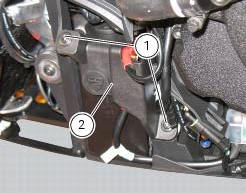
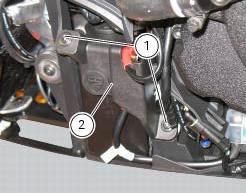
undo the screws (1) and remove the battery retaining bracket (2).
Slide out the battery (3) from its housing and, always starting from the negative terminal (-), loosen the screws (4).
Remove the positive cable (5), the abs positive cable (6) from the positive terminal, and the negative cable (7) from the negative terminal.
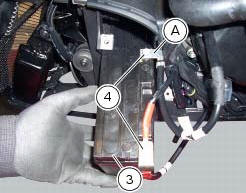
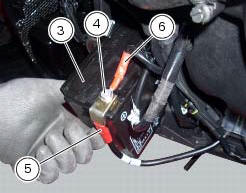
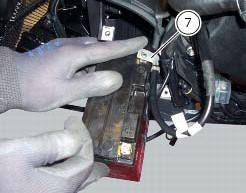
Remove the battery drift (6) on the battery support (7).
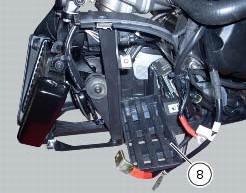
Refitting the battery
Position the battery drift (6) on the battery support (7).
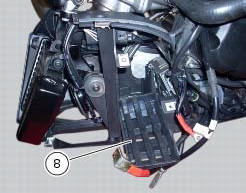
Place the battery (3) in its compartment by connecting first cable (7) to the negative terminal with the screw (4).
Connect the positive cable (5) and then the abs positive cable (6) to the positive terminal with the screw (4).
Tighten the terminal screws (4) to a torque of 10 nm +/- 10% (sect. 3 - 3Frame torque settings) and apply grease around the battery terminal clamps to prevent oxidation.
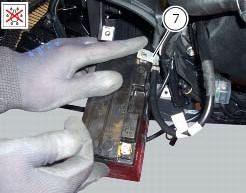
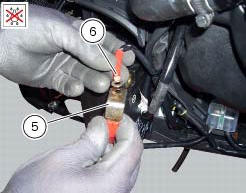
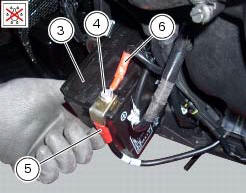
Place the battery (3) on its support, then position the retaining bracket (2) and tighten the screws (1) to a torque of 10 nm +/- 10% (sect. 3 - 3, Frame torque settings).

 Topping up the electrolyte
Warning
Before carrying out any operations on the battery, keep in mind the
safety standards (sect.1 - 3, General safety rules).
The electrolyte in the battery is toxic and can cause burns if it ...
 Alternator
It is equipped with a 12 v, 430 w generator, consisting of a fixed element
(stator, a) located on the generator cover and
of a movable element (rotor, b) fixed to the crankshaft.
Note
To chec ...
Other materials:
Overhaul of the gearbox
Check the condition of the front coupling dogs of the gears. They must be in
perfect condition and with no sign of wear on
the edges of the teeth.
The idler gears must rotate freely on their shafts.
When refitting, make sure the circlips are correctly positioned.
Check the needle roller ...
The immobilizer system
For additional antitheft protection, the motorcycle is
equipped with an immobilizer, an electronic system that
locks the engine automatically whenever the ignition switch
is turned off.
The grip of each ignition key contains an electronic device
that modulates the output signal from a special ...
Final drive
Circlip
Nut
Washer
Nut
Rear sprocket flange
Cush drive bush
Inner ring
Chain
Spacer
Chain cover
Screw
Nut
Lock washer
Front sprocket
Spacer
O-ring
Rear sprocket
Spare parts catalogue
Diavel abs gearbox
Diavel abs rear wheel axle
Diavel carbon
abs
gearbo ...