
Ducati Diavel Service Manual: Changing the clutch fluid
Warning
Clutch fluid will damage painted surfaces if spilled on them. It is also very harmful if it comes into contact with the skin or with the eyes; in the event of accidental contact wash the affected area with abundant running water.
Remove cover (1) and membrane from the clutch fluid reservoir (2) by loosening the screws (3).
Siphon off the fluid from the reservoir (2).
Fill the tank (2) with new oil up to the max. Mark.
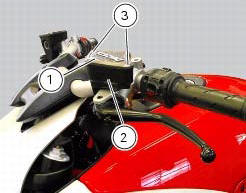
Operate the clutch lever two or three times until the circuit is pressurised.
Hold the lever pulled in towards the grip.
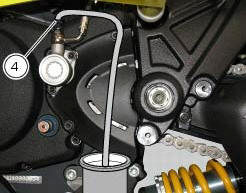
Attach a length of transparent plastic tubing to the bleed valve (4) and insert the other end of the tubing in a container Placed on the floor.
Open the bleed valve (4) to allow fluid to escape.
Warning
During the filling operation, always keep the oil level above the min mark to prevent the formation of air bubbles in the circuit.
Allow the fluid to flow from the bleed valve (4) until it changes colour. Retighten the bleed valve (4) and tighten to a torque of 4 nm +/-10% (sect. 3 - 3, Frame torque settings) and restore the correct level of oil in the tank.
 Changing the brake fluid
Warning
Brake fluid is corrosive and will damage paintwork. Avoid contact
with eyes and skin. In the case of accidental contact,
wash the affected area thoroughly with plenty of running water.
Ch ...
 Draining the clutch hydraulic circuit
Warning
Clutch fluid will damage painted surfaces if spilled on them. It is
also very harmful if it comes into contact with the skin or
with the eyes; in the case of accidental contact, wash the a ...
Other materials:
Adjusting the steering head bearings
Note
To adjust the steering bearing clearance, follow what is described in
sect. 4 - 3, Adjusting the steering head bearings.
If the problems found are not solved, check the wear of steering bearings (6)
and replace them, if necessary, as described
in paragraph "removal of the steering head c ...
Refitting the clutch master cylinder assembly
Insert the clutch master cylinder assembly (3) and the clamp (6) on the left
handlebar, so that the top mating faces
match the mark (z) on the handlebar as shown.
Couple terminal (6) to the clutch master cylinder control and fix them with
the screws (v).
Tighten the retaining screws ...
Refitting the silencer
Position the silencer guard (41) and fix it by starting the screws (40).
Tighten the screws (40) to a torque of 8 nm +/- 10% (sect. 3 - 3, Frame torque
settings).
Insert the silencer (4) into the central exhaust pipe (26), and fix it to the
vehicle by starting the screw (1).
Hold the ...