Ducati Diavel Service Manual: Changing the coolant
Warning
This operation must only be carried out when the engine is cold.
Attempting to change the coolant with the engine hot
could lead to burns from hot coolant or scalding steam.

Place a container under the engine and place the motorcycle on its side stand.
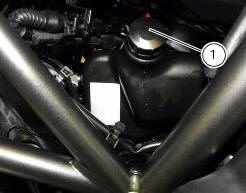
Remove the expansion reservoir filler cap (1).
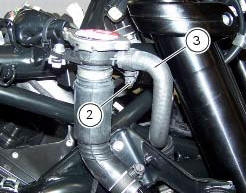
Loosen clip (2), disconnect the hose (3) and drain the coolant inside a container.
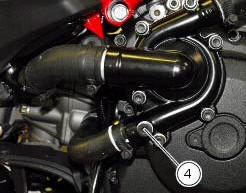
Loosen the cap (4) of the fluid exhaust hole placed on the pump cover.
Allow the coolant to drain off completely.
Screw plug (4) with a seal again in the fluid drain hole, and recover the new seal (5).
Tighten the plug (4) to a torque of 20 nm (min. 18 Nm - max. 22 Nm) (sect. 3 - 3, Engine torque settings).
Refill the circuit by pouring new coolant into the circuit via the remote filler cap (6).
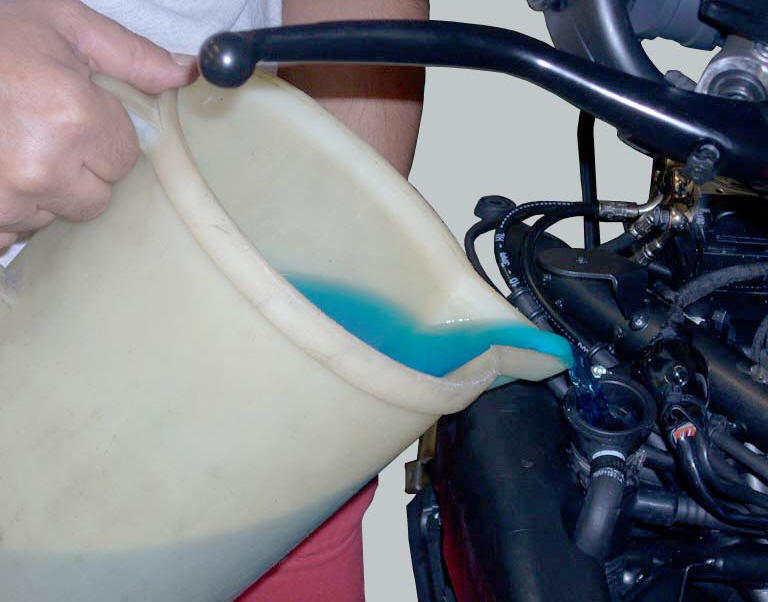
Connect the pipe (3) by tightening the clamp (2) to a torque of 1 nm +/-10% (sect. 3 - 3, Frame torque settings).
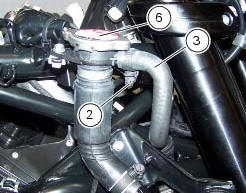
Allow several minutes for the coolant to fill all the internal passages.
Start up the engine and allow the coolant to reach 110 C; run the engine for about 10 minutes.
Stop the engine and allow it to cool down so that all the air is expelled from the cooling circuit.
Warning
Keep your hands, clothing and tools well clear of the radiator fan at all times; this fan starts automatically without warning and could cause serious injury or damage.
Important
Check the cooling circuit for possible leaks.
Top up the coolant through the expansion reservoir filler to bring the level up to the max. Mark.
Tighten the cap (1) of the expansion reservoir.
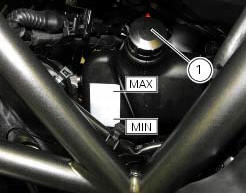

 Checking the coolant level
To the specified intervals in the "scheduled maintenance chart" (sect. 4 - 2)
Check the coolant level contained in
the expansion reservoir, on the right side of the vehicle.
The coolant level mu ...
 Changing the brake fluid
Warning
Brake fluid is corrosive and will damage paintwork. Avoid contact
with eyes and skin. In the case of accidental contact,
wash the affected area thoroughly with plenty of running water.
Ch ...
Other materials:
Fuel tank
fuel tank
Rubber pad
Spacer
Screw
Hose
Tray
Y-fitting
Hose
Hose
Filler cap
Screw
Complete hose guide
Screw
Hose clip
Hose
Screw
Screw
Sealing washer
Screw
Flange
Sealing washer
Spare parts catalogue
Diavel abs fuel tank
Diavel abs fuel system
Diav ...
Changing the brake fluid
Warning
Brake fluid is corrosive and will damage paintwork. Avoid contact
with eyes and skin. In the case of accidental contact,
wash the affected area thoroughly with plenty of running water.
Changing the fluid in the front brake circuit
Remove the cover (1) with the membrane from the front b ...
Start procedure with pin code (no keys)
The motorcycle may be started without keys with a special procedure using the
dashboard and the switches on the
handlebar.
Note
This procedure is only possible if the pin code has been enabled
previously. For security reasons, the pin code is disabled
by default when the vehicle leaves the f ...