
Ducati Diavel Service Manual: Coolant temperature
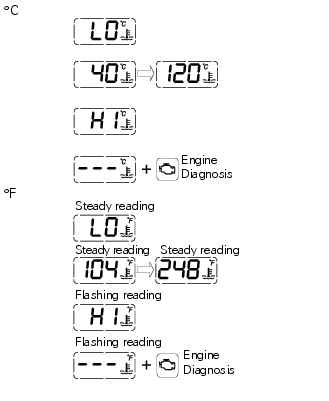
This function indicates coolant indication state.
The temperature unit of measure can be selected (C or f).
The reading is indicated as follows: if the reading is between - 39C and +39C "lo" is shown flashing on the dashboard (steady); if the reading is between +40C and +120C it appears on the dashboard (steady); if reading is +121 C or higher, "hi" is shown flashing on the information panel.
Note
In the event of a sensor "error", flashing dashes ("- - -") are shown and the "engine/vehicle diagnosis - eobd" indicator turns on.
Display background colour (automatic adjustment)
Dashboard background colour is set automatically according to exterior lighting conditions.
When sensor detects "poor lighting" (night), it switches to black background mode; vice versa when a "significant" lighting is detected (day), it switches to white background mode. It is nevertheless possible to customise this function through the "setting" menu function "back light - dashboard 1", on page 62, and possibly set one of the two modes available, night or day, as permanent setting (or go back to auto mode).
 Clock
Clock
This function shows the time.
Time is always displayed as follows:
am from 0:00 to 11:59
Pm from 12:00 to 11:59
If battery power is suddenly cut off (batt-off), when battery power is
restored ...
 Dashboard on tank
Menu 1 (tot, trip1, trip2, trip fuel).
Menu 2 (cons.Avg., Cons., Speed avg, air and trip time) if active.
Gear / neutral indication.
Icon referred to the function below from menu 1.
Indicat ...
Other materials:
Turn indicators not working
Fault codes
Dds: no fault code displayed.
Dashboard: no fault code displayed.
Wiring diagram
Db dashboard connection, bbs bbs unit connection, s turn indicator button, f1
front left turn indicator, f2 front right
turn indicator, f3 rear left turn indicator, f4 rear right turn indicator. ...
Adjusting of the air-gap phonic wheel sensor
(For front as well as rear sensor) in each case of maintenance that foresees:
Replacement or refitting of the wheel
Replacement or refitting of the phonic wheel (1) or (2)
Replacement or refitting of the brake discs
Replacement or refitting of the speed sensor (3) or (4)
(Front) replacem ...
Disassembly of the gearbox shafts
Place the shaft in a vice in such a way as to facilitate the disassembly
operations.
Important
Take care not to invert the positions of the shims on reassembly:
this would potentially lead to jamming when using the gear selector control,
making it necessary to reopen the engine
crankcase.
D ...