
Ducati Diavel Service Manual: Description of the diagnosis instrument (dds)
The "dds" diagnostic system lets you diagnose any faults in the injection-ignition system via a serial port. The system is also equipped with functions to test various devices on the motorcycle. The dds diagnosis instrument can be used to measure current and voltage on any electrical device, to perform tests on individual components and to measure pressure and temperature values.
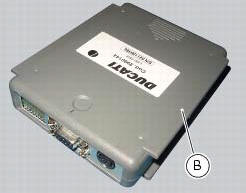
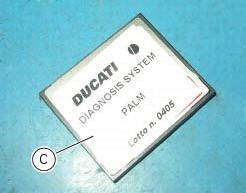
The dds (1) part number 97900.0215 Consists of a palmtop display (a), a bbad self-diagnosis module (b) and a display memory card (c).
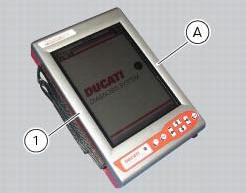
The touch-screen display unit (a) serves for both data display and input, using the stylus housed on the side of the unit.
The self-diagnosis module (b) enables communication between the dds diagnosis instrument (1) and the motorcycle’s on-board electronic control unit (ecu).
The user interface software resides in the display memory card (c) which is housed in the palmtop display unit (a).
The display unit is equipped with two connection panels: one at the top of the instrument and one at the bottom.
The top connection panel has 6 connection sockets with the following functions:
- One vga output (e);
- One port for connection of the measurement module (f);
- One rs232 serial port for connection of peripheral devices (com1) (g);
- A second rs232 serial port for connection of peripheral devices (com2) (h);
- Two generic usb ports (usb1 and usb2) (l).
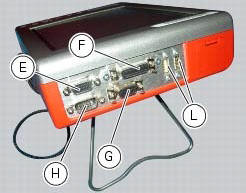
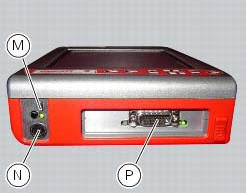
The bottom connection panel has 3 connection sockets with the following functions:
- One usb port (m);
- One power connection socket (n);
- One diagnostics connection socket (p).
You can connect a printer to the dds diagnosis instrument (1) to print test reports: connect the printer to the serial port (com1) (g) located on the top connection panel of the tester (1).
Technical data
Power supply:
- From the mains - 220 v;
- From the vehicle battery - 12 v.
Components supplied with the dds diagnosis instrument
The dds diagnosis instrument (1) is supplied in a kit together with the following items:
- Rechargeable dds battery
- Battery charger
- Mains power adapter
- Usb memory card reader
- Power and diagnostic cable complete with fuse
- Cd containing dds installation software for pc
- Usb cable
- Belt tension sensor
 Using a multimeter to check the electrical systems
Introduction
This instrument allows you to measure resistance, voltages, and current
values. Multimeters can be divided into two basic
types: analogue and digital display multimeter. An analogue m ...
 Tester power supply
The dds (1) part number 97900.0215 Can be powered from the vehicle as
follows:
From the mains power supply: by connecting the power supply connector
(n) to the network power supply (2) pa ...
Other materials:
Adjusting the chain tension
Make the rear wheel turn until you find the position where chain is tightest.
Set the vehicle on the side stand. Push down
the chain at the point of measurement and release. Measure the distance between
the "aperture" upper profile and pin
centre.
The read distance must be: 9 to 11 mm.
...
Dashboard menu option scrolling not possible
Fault codes
Dds: no fault code displayed
Dashboard: no fault code displayed
Location of connections and components
Location of left hand handlebar switchgear set connection.
Pin numbering for wiring harness side dashboard connector. ...
Tips on how to select the sensitivity level
Warning
The 8 level settings of the dtc were calibrated using
tyres of the same make, model and size as those originally
fitted to the motorcycle.
The use of tyres of different size to the original tyres may
alter the operating characteristics of the system.
In the case of minor differenc ...