
Ducati Diavel Service Manual: Injection and ignition
Introduction
Ignition is via a single stick coil per cylinder installed in the spark plug well. Each thermal unit is supplied by a single injector, placed under the throttle valve. The amount of fuel injected and the ignition advances are determined by the control unit specifically for each cylinder. These basic measures are then corrected by the control unit, according to the information supplied by different sensors fitted on the engine and applying certain strategies, in order to obtain the definitive signals of activation. The dtc function (ducati traction control, integrated in the bbs) acts on throttle valve aperture only to control traction as necessary. The dtc function integrated in the bbs communicates with the engine control unit via the can network.
Determination of quantity of fuel injected and ignition advance
The base quantity of fuel injected (defined by the base maps) is determined by the engine control unit using one of two different strategies depending on the operating conditions of the engine:
- If the throttle valve aperture is below a specific threshold, the base quantity of fuel injected is determined using a strategy denominated 'speed-density' (engine speed-intake manifold pressure). There is therefore one base fuel quantity map with coordinates correlating the quantity of fuel injected with engine speed-pressure for cylinder 1 (horizontal) and another for cylinder 2 (vertical)
- If the throttle valve aperture is over a specific threshold, the base quantity of fuel injected is determined using a strategy denominated á-n (throttle valve aperture angle-engine speed). There is therefore one base fuel quantity map with coordinates correlating the quantity of fuel injected with engine speed-throttle valve aperture for cylinder 1 (horizontal) and another for cylinder 2 (vertical)
- At intermediate throttle valve apertures between the two thresholds described above, the base quantity of fuel injected is determined by applying the two strategies simultaneously
The base ignition advance (defined by the base maps), is determined by the engine control unit using the á-n (throttle valve aperture angle-engine speed) strategy. There is therefore one base ignition advance map with coordinates correlating the quantity of fuel injected with engine speed-throttle valve aperture for cylinder 1 (horizontal) and another for cylinder 2 (vertical).
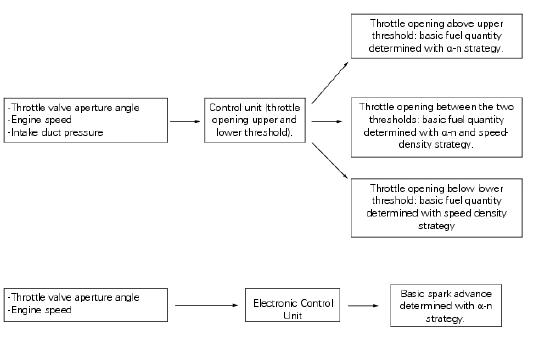
The two diagrams illustrate how the engine control unit determines the base quantity of fuel injected and the base ignition advance.
During the progression stage - at throttle valve aperture angles immediately above idle speed angles - using the speeddensity strategy allows more precise determination of engine load (air aspirated by engine), resulting in smoother power delivery.
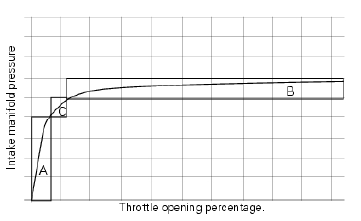
The diagram quantitatively illustrates how pressure in the intake duct varies in relation to increases in throttle valve aperture angle. At small aperture angles, the pressure varies considerably (zone a). As a result, the speed-density strategy is used as it allows engine load to be determined more precisely. At larger aperture angles, pressure varies by little (zone b). As a result, the á-n strategy is used to determine engine load more precisely. Both strategies are used in the transitional zone c.
Specific strategies applied to injection and ignition: transitional pickup acceleration, cut-off and rev limiter
During sudden acceleration (high throttle valve apertures), the engine control unit implements the transitional pickup acceleration function (serving a function similar to the accelerator pump used in carburettors) that enriches the mixture to ensure the necessary fluid power delivery.
When the throttle valves are closed abruptly, the engine control unit implements the cut-off function, which reduces the quantity of fuel injected to reduce consumption and emissions. At engine speeds approaching idle, the injection quantity and throttle valve aperture are managed appropriately to prevent stalling.
The rev limiter is implemented progressively, reducing the quantity of fuel injected and ignition advance increasingly as the engine speed approaches the maximum limit. Upon reaching the rev limit, no fuel is injected and ignition is disabled.
The injection phase
The injection system is phased, meaning that the engine control unit activates the injectors during the exhaust stroke of each cylinder, so that the air-fuel mixture fills the cylinder correctly during the subsequent intake stroke. The precise instant in which the injector opens is determined by calculating the closure time and the time interval during which the injector is required to remain open (injection time). The injection phase is defined by two maps containing the crankshaft angles at which the injectors must be closed. One of these maps is for the horizontal cylinder, the other is for the vertical cylinder. These maps contain coordinates correlating throttle valve opening-engine speed (á-n).
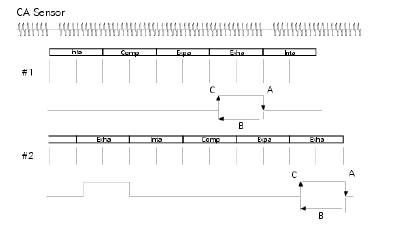
The diagram illustrates the strategy used to determine the injection phase for each cylinder. The map contains the value a, which varies in relation to engine speed and throttle valve opening (á-n). After calculating the injection time (which equates to an angle b correlated to engine speed), the engine control unit may determine the injection start time - in other terms the injection phase c - by subtraction.
Absolute pressure sensor readings
As the signals generated by the two absolute pressure (map) sensors connected to the two intake manifolds are fundamental for the speed-density strategy, it is important to understand how the engine control unit reads these signals.
Absolute pressure sensor 1 is connected to the intake duct for cylinder 1 (map 1, cylinder 1 - horizontal), whereas absolute pressure sensor 2 is connected to the intake duct for cylinder 2 (map 2, cylinder 2 - vertical). Therefore, map 1 is associated with the base injection map for cylinder 1 (horizontal) and map2 is associated with the base injection map for cylinder 2 (vertical).
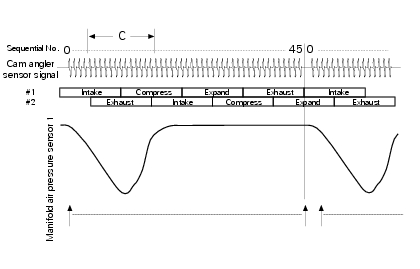
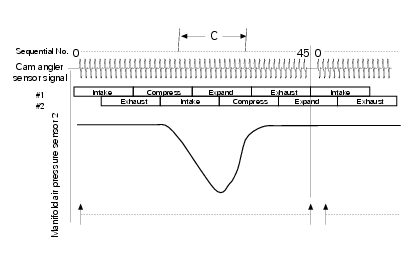
The two diagrams compare the engine speed-timing sensor signal with the signals generated by the sensors map1 and map2. As can be seen, the intake pressure is measured during the intake stroke for each cylinder (zone c).
The map 1 sensor is also used to measure atmospheric pressure. This measurement is taken during the combustion stage of cylinder 1 (horizontal). In the event of a fault in map 1, atmospheric pressure is measured by map 2. Information relative to atmospheric pressure is used by the engine control unit to make the corrections necessary to the fuel-air mixture in relation to altitude.
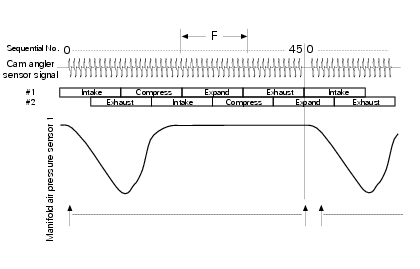
The diagram relative to the map1 sensor compares the engine speed-timing signal with the signal generated by the map1 sensor itself. As can be seen, atmospheric pressure is measures during the combustion stroke for cylinder 1 (horizontal) (zone f).
Note
With coolant temperature above 80 C and air temperature within 19 C and 35 C, the co value on each cylinder shall be comparable and comprised within 0.4% Vol. And 1.4% Vol.. Under these conditions the idle must correspond to 1350 rpm +/- 100 rpm.
The temperatures and engine rpm values can be read with the dds.
To detect the co level screw the threaded adapters, where to insert the gas sampling probe, on the two exhaust manifolds.
Before reading the value displayed by the exhaust gas analyser wait at least one minute for the measurement to stabilise.
 Fuel system circuit
The fuel system circuit consists of:
An electric pump, driven by the injection relay, which is in turn
controlled by the ecu (engine control unit)
A fuel filter
A pressure regulator
Two i ...
 Operating principle and characteristics of the ride-by-wire system
The engine control system of the diavel uses a ride-by-wire system with
motorised throttle valves. This eliminates all
direct connection with metal cables between the throttle grip and the throttle ...
Other materials:
Removal of the front brake system
Note
For the abs front braking system, also refer to sect. 7 - 5, Abs system
operating information, sect. 7 - 6, System
components, sect. 7 - 7, Abs components maintenance.
Undo the special screw (3), collect the sealing washers (4), and release the
front brake master cylinder assembly (1 ...
Removing the water radiators
Loosen the screws (p) that retain the supports (s) of the front splashguard
to the air ducts (24) and (26).
Loosen the screws (30), to separate the two internal air ducts (24) and (26).
Disconnect the wiring connectors of the main wiring loom (c) from both fans.
Disconne ...
Gearchange mechanism
Return spring
Washer
Special screw
Gear pawl assembly
Interlock plunger holder
Sealing washer
Detent ball spring
Ball
Circlip
Selector claw return spring
Shim washer
Ring
Nut
Selector drum control fork
Gearchange lever pin
Shaft with gearchange lever arm
Gearch ...