
Ducati Diavel Service Manual: Operating principle
Introduction
The hands free system features two separate on/off buttons, either one of which may be used as preferred by the rider.
For practical reasons, we recommend using the button on the handlebar rather than the button located underneath the plastic shield covering the hands free system (in front of the tank).
In order to be able to turn the motorcycle on, the active key (which may be kept in the pocket, for instance) must be within 1.5 Metres from the antenna located inside the document compartment under the seat. In case the active key charge is low or ignition by means of the passive key it is necessary to start the bike while keeping the key against the antenna.
If the steering lock is locked and the key is recognised, pressing the on/off button automatically disengages the lock.
Pressing and holding one of the two on/off buttons causes the hands free system to send a radio signal to the key commanding it to "wake up" its internal electronic circuit. This function prevents the battery inside the key from draining when not in use, in other terms, when out of range or when the motorcycle is switched off. In these conditions, the internal circuit goes into a standby state. When the key receives the "wake up" signal, it activates its internal circuit and begins transmitting the unlock code to the hands free by radio. If the unlock code received by the hands free system is correct, engine start is enabled and the dashboard switches on.
The procedure for using the passive key (or for using the active key in transponder mode) is similar to the procedure with the active key. However, the passive key has no internal battery providing power for transmission, and the power necessary is received from the hands free system antenna instead. For this reason, the passive key must be aligned perfectly with and placed close to the antenna to ensure that it is powered and recognised. When the electronic circuit inside the key receives power from the antenna, it begins to transmit the unlock code to the hands free system. If the unlock code is correct, engine start in enabled and the dashboard switches on.
Two keys are provided with the motorcycle: one active key and one passive key. The active key has its own battery and communicates remotely with the hands free system, whereas the passive key, which is only used if the active key is not working, must be placed over the antenna (transponder mode - emergency start). The mechanical part of the key is used to open the saddle and fuel cap locks (if the vehicle is not equipped with electric locks). The two keys are shown below.
Warning
Never ride the vehicle with either of the keys (active or passive) inserted in the fuel cap or saddle lock as this may damage the mechanical part of the key or its internal electronic circuits.
Warning
Never leave the key on the vehicle when washing the vehicle itself as the key is not watertight and may be damaged.
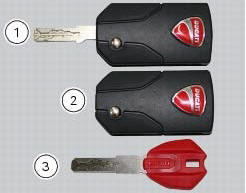
This photo shows the active and passive keys. From top to bottom:
- Active key with mechanical part unfolded;
- Active key with mechanical part folded;
- Passive key
How to turn the motorcycle on
In order to switch the dashboard on and start the engine, the active key must be within 1.5 Metres from the bike seat covering the receiver antenna.
 Introduction to the "hands free" system
The hands free system allows the rider to start the engine without physically
using the ignition key. The ignition key
merely has to be in the vicinity of the motorcycle, such as in the rider's
p ...
 How to switch the dashboard on
The dashboard may switched on either from the on/off switch on the handlebar
or from the button on the hands free
system.
With the engine off, the on/off switch is turned to "run off".
With ...
Other materials:
Changing the engine oil and filter cartridge
Note
This operation has to be carried out with hot engine (but turned off)
because the oil in these conditions is more fluid and
its evacuation is faster and complete.
Remove the drain plug (3) with seal (a) from the oil sump and allow the oil
to drain off.
Warning
Dispose of oil and/or fil ...
Headlight control
This function allows you to reduce current consumption from
the battery, by automatically managing headlight switchingoff.
At key-on, the high beam and low beam lights are off.
When the engine is started, the low beam lights turn on
automatically; from this moment, "normal" operati ...
Introduction to the "hands free" system
The hands free system allows the rider to start the engine without physically
using the ignition key. The ignition key
merely has to be in the vicinity of the motorcycle, such as in the rider's
pocket, for example, in order to use the vehicle.
Compared to the standard ignition switches the h ...