
Ducati Diavel Service Manual: Operating principle
The ducati abs brake system manages the front and rear brakes separately. A pulse generator (phonic wheel), with a ring of slots, is fixed onto each wheel. On the left calliper mounting bracket of the front fork and on the rear brake calliper holder plate are hall effect sensors which detect the full sections and voids on the phonic wheel as the vehicle moves, providing and instantaneous wheel speed reading. These sensors transmit the data to the abs control unit, which contains software implementing a specific control algorithm developed by ducati. The software compares the average speed of the vehicle against the instantaneous wheel speed values to determine the degree of skidding. If the pressure applied to the calliper by the rider causes the control limits to be exceeded, the control unit intervenes in the braking circuit relative to the wheel for which incipient lock-up is detected. The abs modulates the calliper pressure with a system of solenoid valves that initially prevents any further increase in hydraulic pressure (ev valve closed), and then reduces pressure (av valve opened). The av valve is opened in a series of pulses (with less than 10 milliseconds between successive pulses), to reduce pressure in steps. When the wheel begins to rotate again in response to the diminished braking force applied and the wheel speed reaches the reference value, the av release valve is closed.
Simultaneously, the ev inlet valve is reopened, restoring normal operation of the brake system. The abs control unit can monitor and modulate brake force accordingly in the three following different conditions: dry road surface (high grip), wet or greasy road surface (poor grip) and uneven road surface. Abs functionality is disabled at vehicle speeds lower than 5 km/h.
A diagram illustrating how the abs system functions is given below.
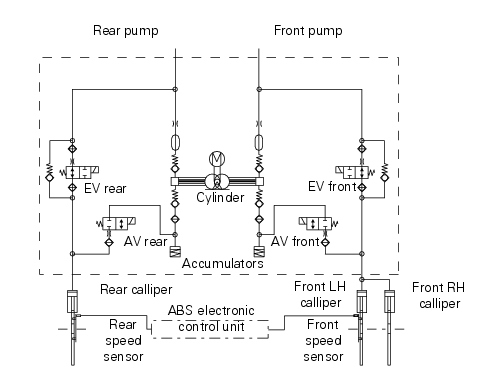
The hydraulic component of the abs system consists of a primary circuit (from the cylinder to the control unit and from the control unit to the calliper) and a secondary circuit (completely within the control unit). The hydraulic layout of the abs system is given below.
Key for abs hydraulic system layout


 Abs system operating information
The response of the system is based on the analysis of the speed signals for
front and rear wheels; the system is
automatically deactivated if either of these signals is missing.
Note
In the even ...
Other materials:
Introduction to the engine control system
The engine control system used on the diavel consists of the following
elements:
Ride-by-wire system (motorised throttle valves with electric actuator,
throttle grip position sensor and throttle valve
position sensor)
One injector per cylinder installed downstream of throttle valve
On ...
Reassembling the electrical components support
Check the presence of clips (1), (9) and (24) on the support (5).
Check the presence of rubber pads (6) and (8) and of cable grommet (7).
Check that the voltage regulator (3) and the solenoid starter (18) are in
place on the support (5) with their wiring as
shown.
The horn (22) mus ...
Disassembly of the gearchange mechanism
Refer to the exploded view at the beginning of this section for indications
on disassembly and renewal of gearchange
components.
If the bushing (2) inside the pedal (1) needs replacing, grease the external
surface and drive the new bushing into place
using a press. The bushing must be seate ...