
Ducati Diavel Service Manual: Refitting the expansion tank
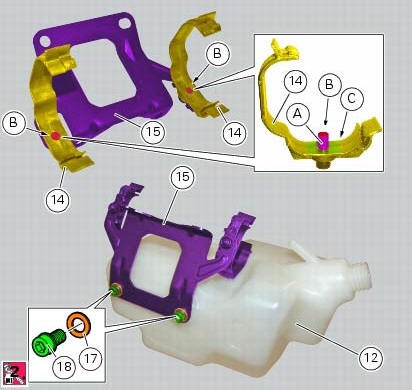
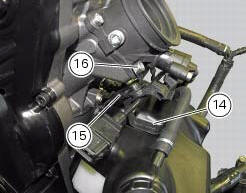
If the support (15) has been removed, place the hose clamps (14) on the bracket (15) orienting them as indicated.
Fully press the pins (a) to block the clamps (14) until pins surfaces (b) are at the same level of the clamps (14) surfaces.
Apply recommended threadlocker to the thread of the screws (18) and insert them into washers (17).
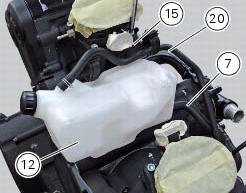
Place the bracket (15), as indicated, on the expansion reservoir (12) and tighten the screws (18) to a torque of 5 nm +/- 10% (sect. 3 - 3, Frame torque settings).
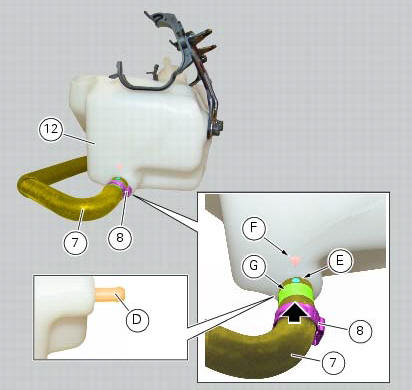
Fit the clip (8) on the hose (7).
Insert completely the hose (7) into the lower fitting (d) of the expansion reservoir (12), by orienting it so as the reference (e) of the hose matches with the arrow in relief (f) on the expansion reservoir.
Note
In case of difficulties during insertion of the hose (7) into the fitting (d) it is recommended to apply lubricant suitable for rubber to the fitting.
Orient the clamp (8) as indicated and bring it in correspondence with the area (g) of the hose (7).
Tighten the clip (7).
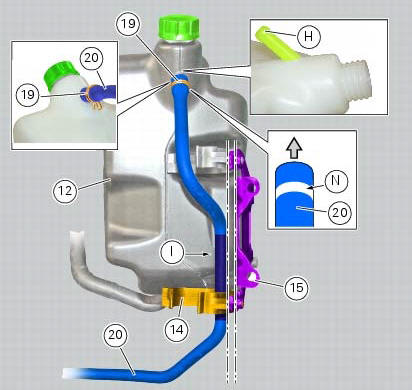
Fit the clip (19) on the hose (20).
Insert completely the hose (20) on the upper fitting (h) of the expansion reservoir (5), so that the straight part (l) of the hose is parallel to the bracket (2) as highlighted by the axes (l) and (m).
Note
The hose (20) side to be inserted in the fitting (h) features the white padprinting (n).
Important
Once the assembly is completed, the hose (20) must be in contact with the internal surface of the hose clamp (1) as indicated.
Note
In case of difficulties during insertion of the hose (20) into the fitting (h) it is recommended to apply lubricant suitable for rubber to the fitting.
Block the hose (20) by means of the clip (19), by orienting it as shown.
Insert
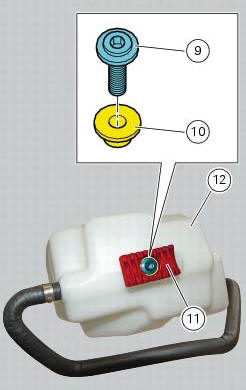
Insert the spacer with the collar (10) into the hole of the rubber mounting (11).
Fit the rubber mounting (11) as shown, by starting the screw (9).
Tighten the screw (9) to a torque of 8 nm +/- 10% (sect. 3 - 3, Frame torque settings).
Position the tank (12) with its hoses (7) and (20) and the support (15).
Position the pipes inside the clamps (14) and close them.
Tighten the screws (16) to the torque of 8 nm +/- 10% (sect. 3 - 3, Frame torque settings).
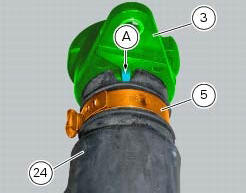
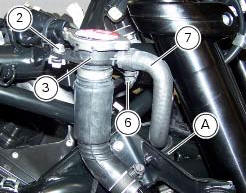
If hose (24) had been removed, insert the clip (5) on the hose (24) at the position shown.
Fit the union (3) on the hose (24) and secure it using the clamp (5).
Note
If hose (24) had been removed, insert the clip (5) on the hose (24) at the position shown.
Fit the union (3) on the hose (24) and secure it using the clamp (5).
Note
The union (3) must be oriented so that the groove on hose (24) matches the tab (a) on the hose. Orient the clamp (5) as indicated.
Refit the coolant circuit remote filler (4).
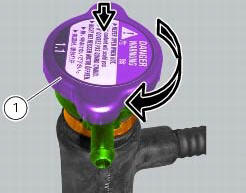
Position the union (3) on the frame by tightening the screw (2) to a torque of 5 nm +/- 10% (sect. 3 - 3, Frame torque settings).
Place hose (7) on the union (3) with clip (6) and tighten the latter to a torque of 1 nm +/- 10% (sect. 3 - 3, Frame torque settings).
Insert the hose (7) inside the hose guide (a).
 Removal of the expansion tank
Loosen the clamp (6), open the hose guide (a) and slide the hose (7) out of
the radiator.
Open clamps (14) and release the hoses that pass through them.
Loosen the screws (16).
Remove ...
 Removal of the cooling system hoses and unions
Loosen the clips (21) that secure the radiator/thermostat sleeve (40) and the
radiator/plug sleeve (24) to the water
radiators.
Loosen clips (25) and (43) that secure the breather pipe ...
Other materials:
Recharging the battery
Examine the label on the battery showing the check intervals in order to
determine when to test the voltage.
Charge the battery if the open circuit voltage is lower than 12.8 V. Leaving
the battery discharged for more than one
month could damage it. Check the battery charge with a voltmete ...
Adjusting the clutch lever and front brake lever
The clutch lever (1) is fitted with a span adjuster (2) which serves to alter
the distance of the lever from the handlebar.
The lever distance can be adjusted through 10 clicks of the dial (2). Turn
clockwise to increase lever distance. Turn the
adjuster counter clockwise to decrease lever d ...
Checking and adjusting timing belt tension
Note
The on-screen icons used during this procedure are explained in a table at
the end of this section.
Note
This operation, which is performed using the dds diagnosis instrument, has
the advantage that it can be carried out on
both timing belts with the engine still installed on the frame. ...