
Ducati Diavel Service Manual: Removing the valve rocker arms
With the cylinder head in the condition described in the previous paragraph, remove the rocker arms.
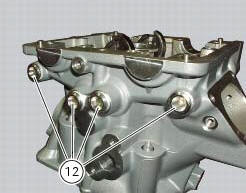
Unscrew the eight plugs (12) and recover the seals (15).
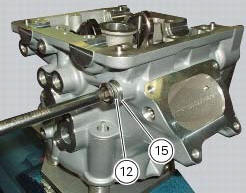
Using an m6 screw, withdraw the shafts (2) of the opening rocker arms (3) on the exhaust and intake sides.
Remove the opening rocker arms (3).
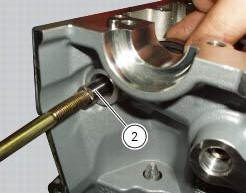
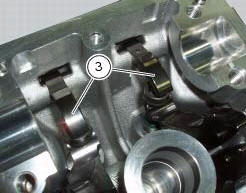
Using the claw of the rocker arm spring tensioning kit 88713.2069 Installed between the spring and the inner wall of the cylinder head, move the straight end of the rocker arm return spring (19) and (18) and insert it in the drilled shaft.
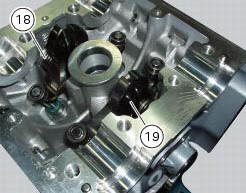
Use the shaft to slide the end of the spring into its final position.
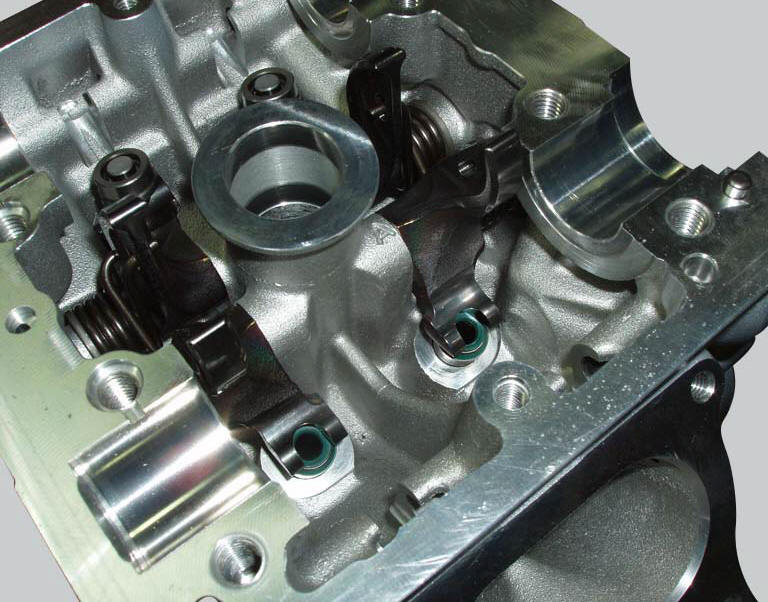
Using an m6 screw, withdraw the shafts (1) of the closing rocker arms on the exhaust and intake sides.
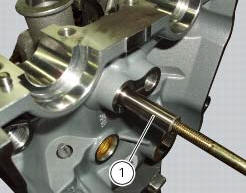
Remove the closing rocker arms (4) and (16), the springs (18) and (19) with the spacers (17).
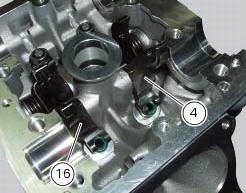
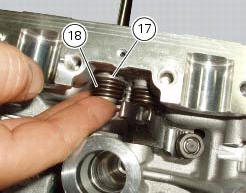
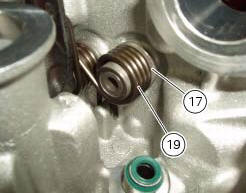
Carry out the same operation to remove the closing rocker arms (4) and (16), the springs (24) and (25) with the spacers (23).
Remove the sealing rings (8) from the ends of the valve guides.
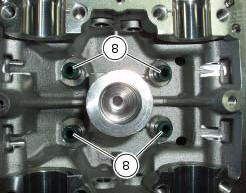
Repeat the same procedure for the other cylinder head.
 Removing the valves
Raise the rocker arm (3) and remove the opening shim (5) from the valves with
a pair of pliers.
Push down the closing rocker arms (16) and (4) and the closing shim (7).
Remove the half r ...
 Overhaul of cylinder head components
Cylinder heads
Remove any carbon deposits from the combustion chamber and its ducts.
Remove any scale from the coolant ducts.
Check for cracking and inspect the sealing surfaces for scoring, ri ...
Other materials:
Clutch
Screw
Ring
Clutch spring
Pressure plate
Bearing
Circlips
Nut
Belleville washer
Clutch plates
Belleville washer
Flat ring
Clutch centre
Spacer
Clutch lifter
Spare parts catalogue
Diavel abs clutch
Diavel carbon
abs
clutch
Important
Bold reference numbers in t ...
Immobilizer override procedure
This procedure makes it possible to "temporarily" turn on the motorcycle if
the hf (hands free) system is not working.
Note
The pin code function must be activated by entering your 4 digit pin in
the dashboard, otherwise the vehicle cannot be
turned on temporarily in the case of a malfunction ...
Spark plugs replacement
Check the colour of the ceramic insulation around the central electrode:
an even, light brown colour indicates the engine is in good condition and
running at the right temperature.
Inspect the centre electrode for wear and check spark plug gap, which should be:
0.8+/-0.1 Mm.
Important
...