
Ducati Diavel Owners Manual: Riding mode customisation
This function customises each riding style.
To access the function it is necessary to view the "setting"
menu page 48, using button (1, fig. 14) ?
or (2, fig. 14)
? select the "riding mode" function
and press the
reset button (12, fig. 12) To go to next page.
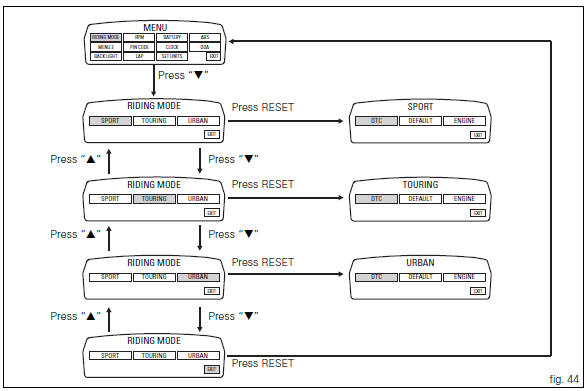
When accessing the function, the three riding modes appear
on the display; to customise the parameters, use button (1,
fig. 14)  or (2, fig. 14)
 to select the riding mode to
be changed and press the reset button (12, fig. 12) To
confirm.
The parameters that can be "customised" are "dtc" (ducati traction control) and "engine".
Any parameter change made is saved in the memory also after a battery-off.
To change the dtc parameters see the "dtc (ducati traction control)" paragraph page 52.
To change the engine parameters see the "engine (engine power control)" paragraph page 56.
The parameters set by ducati for each individual riding style can be restored with the "default" function.
To reset the "default" parameters see the "default (resetting ducati default parameters)" paragraph page 58.
 Note
Note
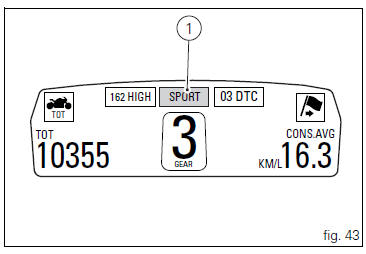
If the parameters have not been modified (customised) or are reset using the "default" function, when you quit the setting menu, in the "main" screen, the "background" indicating the riding style (sport, touring or urban) becomes blue (1, fig. 43).
 Warning
Changes should only be made to the parameters by people who are experts in motorcycle setup; if the parameters are changed accidentally, use the "default" function to reset the parameters.
 Setting menu
This menu is used to enable/disable and set some
motorcycle functions.
To access the "setting menu" press the button (2, fig. 14)
? for 3 seconds.
Note
When within this menu no ...
 Dtc (ducati traction control) setting function
This function allows you to customise the level of dtc
intervention (ducati traction control) or disable it for every
riding mode.
To access the function it is necessary to view the "setting ...
Other materials:
Refitting the hands free
Reassembly is a reversal of the removal procedure: in particular apply
prescribed threadlocker to screws (2) and tighten
them to a torque of 20 nm +/- 10% (sect. 3 - 3, Frame torque settings).
If the hands free button has been previously removed, when refitting it insert
the spring (6) on pi ...
Adjusting the position of the gearchange and rear brake
pedals
The position of the gearchange and rear brake pedals in
relation to the footrests can be adjusted to suit the
requirements of the rider.
Adjust the pedals as follows:
Gear change pedal (fig. 97)
Hold the linkage (1) and slacken the lock nuts (2) and (3).
Note
Nut (2) has a left-hand thr ...
Indicator cons. - Instantaneous fuel consumption
This function indicates the "instantaneous" fuel consumption.
The calculation is made considering the quantity of fuel used and the distance
travelled during the last second. The datum
is expressed in "l / 100" (litres / 100 km); it is possible to change the units
of measurement for "consump ...