
Ducati Diavel Service Manual: Replacing the front phonic wheel sensor

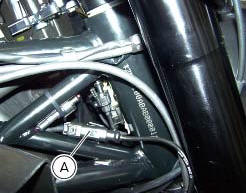
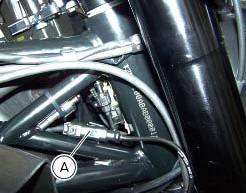
Disconnect the front abs sensor (2) connector (a) from the main electric wiring.
Open all the retainer clamps of the front abs sensor cable (2): refer to table of sect. 7 - 6, Flexible wiring/hoses positioning.
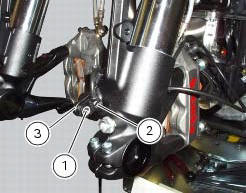
Loosen retaining screw (1) and remove the front abs sensor (2) with calibrated gasket (3).
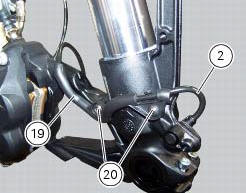
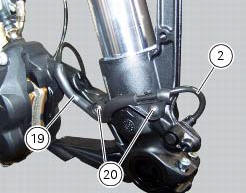
Undo the screws (20), remove the guide (19) and slide out the front abs sensor cable (2).
Before refitting, make sure that the contact parts between the front abs sensor (2) and its seat are not damaged and are perfectly clean.
Fit the new front abs sensor (2) in the relevant seat.
Insert the front abs sensor cable (2) in the guide (19) and fix it on the lh fork leg by starting the screws (20).
Tighten the screws (20).
Refit the front wheel as indicated in sect. 7 - 1, Refitting the front wheel.
Connect the connector (a) to the main wiring.
Restore all the retainer clamps of the front abs sensor cable (2): refer to table of sect. 7 - 6, Flexible wiring/hoses positioning.
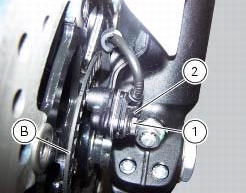
Check the air gap between the front abs sensor (2) and the front phonic wheel (b) as indicated in sect. 7 - 7, Adjusting of the air-gap phonic wheel sensor.
Tighten the screw (1) to the torque of 10 nm +/- 10% (sect. 3 - 3, Frame torque settings).
 System components
Screw
Abs front speed sensor
Sealing washer
Hose grommet
Abs rear speed sensor
Abs control unit
Front pump - control unit pipe
Control unit - front callipers pipe
Rear pump - co ...
 Replacing the rear phonic wheel sensor
Disconnect the rear abs sensor (5) connector (c) from the main electric
wiring.
Open all the retainer clamps of the rear abs sensor cable (5): refer to table of
sect. 7 - 6, Flexible wiring ...
Other materials:
Removal of the handlebar
Unscrew and remove the screws (3) securing the upper clamp (1).
Remove the upper clamp (1).
Remove the handlebar (4) from its seat on the steering head.
To remove the grips (5), refer to the exploded view at the beginning of this
chapter.
...
Engine on/off
Warning
Before starting the engine, become familiar with the
controls you will need to use when riding (page 99).
Warning
Never start or run the engine indoors. Exhaust gases
are toxic and may lead to loss of consciousness or even
death within a short time.
In the presence of the active or ...
Refitting the tail light
Fit the spacers with collar (3) into the rear vibration dampers (2) located
on the gloves compartment (23).
Note
Two spacers (3) must be inserted inside and outside on the right side and
two spacers (3) must be inserted inside and
outside on the left side.
Insert the split vibration damp ...