
Ducati Diavel Owners Manual: Tank filler plug
 Note
Note
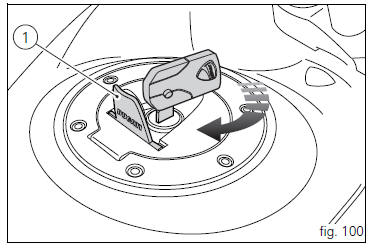
To open or close the tank filler plug using the active key, set the metal part in the middle position, as shown on page 86.
Opening
Lift the cover (1, fig. 100) And insert the active or passive key into the lock. Give the key a 1/4 turn clockwise to unlock.
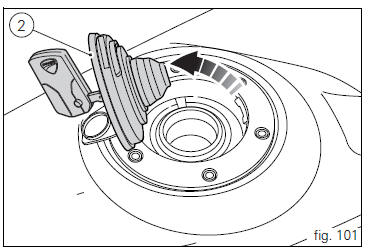
Lift the plug (2, fig. 101).
Closing
Close the cap (2, fig. 101) With the key inserted and press it into its seat. Remove the key and replace the lock cover (1, fig. 100).
 Note
Note
The cap can only be closed with the key inserted.
 Warning
Always make sure you have properly refitted (see page 140) and closed the plug after each refuelling.
Seat lock
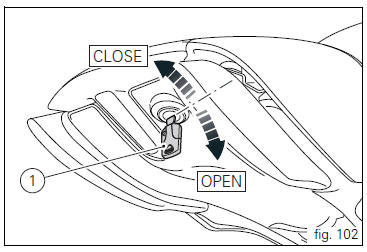
Work latch (1, fig. 102) To remove the seat and access to the underseat compartment and any other device under it.
 Position on the vehicle
Tank filler plug.
Seat lock.
Side stand.
Rear-view mirrors.
Front fork adjusters.
Rear shock absorber adjusters.
Catalytic converter.
Exhaust silencer (see "warning" on ...
 Side stand
Insert the active or passive key in the lock (1, fig. 102), Turn it
clockwise and simultaneously apply downward pressure in
the area of the catch to release the pin. Pull the seat
backwards to rele ...
Other materials:
Removal of the rear shock absorber
Loosen the screws (22) and remove the assembly (34) from the frame.
Loosen the screws (27) and remove the tank unit (s) of the shock absorber
from the support (19).
Hold the lh bush (6) and loosen the rh bush (5) to release the front side of
the shock absorber assembly.
Un ...
Checking valve clearances
To check the valves clearance, it is necessary to have access to the cylinder
head covers and then remove the
components listed below.
Unscrew the two fixing screws (1) of the cover (2) according to the
crankshaft.
Fit the tool handgrip 88713.0123 In the holes of the generator cover t ...
Legal rights
This warranty gives you specific legal rights, and you may
also have other rights which vary from state to state.
This warranty is in addition to the ducati limited
motorcycle warranty.
Additional information
Any replacement part that is equivalent in performance and
durability may be used in ...