
Ducati Diavel Service Manual: Battery
Battery safety rules
Warning
Before carrying out any operations on the battery, keep in mind the safety standards (sect. 1 - 3, General safety rules).
When under charge, batteries produce explosive gases. Keep batteries away from heat sources, sparks or open flames.
Instructions for use
The battery is a sealed, maintenance-free type and therefore requires no servicing installation.
Note
Always keep the battery clean. Apply grease around the battery terminal clamps to prevent corrosion.
Warning
Never remove the valve cover located on top of the cover. If the block, cover or terminals are broken or if the valve cover has been tampered with it is absolutely necessary to replace the battery.
Important
If the motorcycle is left unused for more than 30 days, remove the battery and store it in a safe, cool place.
Always charge the battery before the first operation and after long storage periods - such as before selling the vehicle.
Removal of the battery 
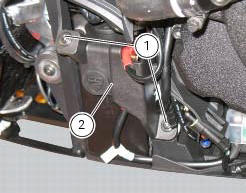
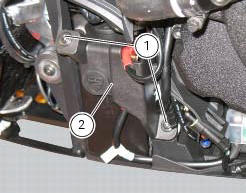
undo the screws (1) and remove the battery retaining bracket (2).
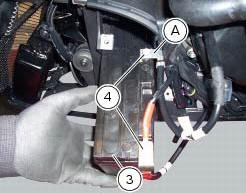
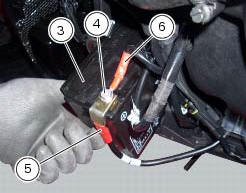
Slide out the battery (3) from its housing and, always starting from the negative terminal (-), loosen the screws (4).
Remove the positive cable (5), the abs positive cable (6) from the positive terminal, and the negative cable (7) from the negative terminal.
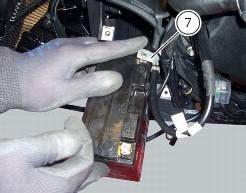
Remove the battery drift (6) on the battery support (7).
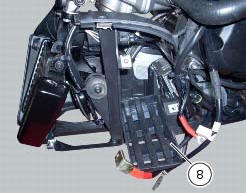
Refitting the battery
Position the battery drift (6) on the battery support (7).
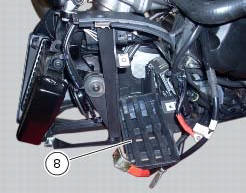
Place the battery (3) in its compartment by connecting first cable (7) to the negative terminal with the screw (4).
Connect the positive cable (5) and then the abs positive cable (6) to the positive terminal with the screw (4).
Tighten the terminal screws (4) to a torque of 10 nm +/- 10% (sect. 3 - 3Frame torque settings) and apply grease around the battery terminal clamps to prevent oxidation.
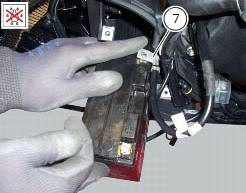
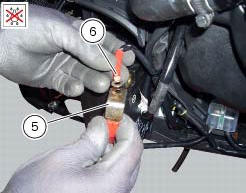
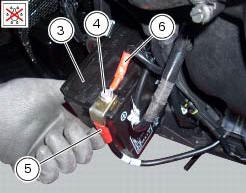
Place the battery (3) on its support, then position the retaining bracket (2) and tighten the screws (1) to a torque of 10 nm +/- 10% (sect. 3 - 3, Frame torque settings).

 Topping up the electrolyte
Warning
Before carrying out any operations on the battery, keep in mind the
safety standards (sect.1 - 3, General safety rules).
The electrolyte in the battery is toxic and can cause burns if it ...
 Alternator
It is equipped with a 12 v, 430 w generator, consisting of a fixed element
(stator, a) located on the generator cover and
of a movable element (rotor, b) fixed to the crankshaft.
Note
To chec ...
Other materials:
Tft - parameter setting/display
Warning
Any adjustments to the instrument panel must only be
carried out when the motorcycle is stationary. Never operate
the instrument panel controls while riding the motorcycle.
At the end of the check, the instrument panel always
displays as the "main" indication the odometer (to ...
Removal of the fuel tank filler cap
Remove tank covers (sect. 5 - 2, Removal of the fuel tank fairings).
Remove hoses (8) and (15) from the filler cap assembly (10).
Open the filler cap.
Unscrew the outer screws (17) securing the ring nut to the filler cap recess.
Remove the filler cap assembly (10).
...
Limitations
This emission control system warranty shall not cover any
of the following:
Repair or replacement required as a result of
Accident,
Misuse,
Repairs improperly performed or replacements improperly
installed,
Use of replacement parts or accessories not conforming
to ducati specifi ...