
Ducati Diavel Service Manual: Refitting the front brake master cylinder
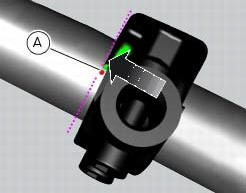
Insert the front brake master cylinder unit (1) on the right side of the handlebar to bring the terminal internal edge in correspondence to the bolted joints (a).
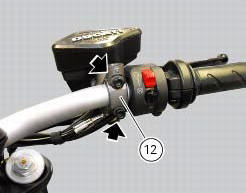
Fit the terminal (12) on the handlebar inserting the screws (15).
Tighten the terminal (12) retaining screws to a torque of 10 nm +/- 10% (sect. 3 - 3, Frame torque settings) following the sequence 1-2-1 starting from the upper screw.
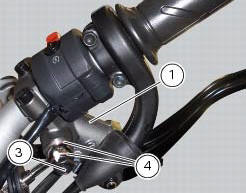
Locate the pipe with sealing washers (4) on the master cylinder assembly (1) and secure it with the special screw (3), without tightening it.
Warning
An incorrectly positioned hose can cause clutch faults and interfere with moving parts.
Orientate the pipe (24) as illustrated in the figure and then tighten the special screw (3) to a torque of 23 nm +/- 10% (sect. 3 - 3, Frame torque settings).
In order to fit the pipe (24) and the retaining clips, follow instructions in sect. 7 - 6, Flexible wiring/hoses positioning.

 Removal of the front brake master cylinder
Warning
The brake master cylinder manufacturer advises against servicing the
brake master cylinder due to the safety critical
nature of this component. Incorrect overhaul of these critical safety ...
 Maintenance operations
Warning
Brake fluid is corrosive and will damage paintwork. Avoid contact
with eyes and skin. In case of accidental contact, wash
the affected area with abundant running water and consult a doctor ...
Other materials:
Refitting the gearchange mechanism
Make sure that the gearchange linkage assembly (6) is installed with the ball
joint with a left-hand thread (a) facing the
lever (8).
Apply the recommended grease to the non-threaded surface of the pin (4).
Fit the first o-ring (5) in the pin (4).
Start the pin (4) in the gearchange leve ...
Removal of the water pump
Note
For clarity, the figures show the engine removed from the frame.
Loosen and remove the water pump cover (12) fixing screws (13) to the
generator cover (16).
Remove the water pump cover (12).
Clean the pump housing of any scale. Check the bearings wear by turning the
impeller s ...
Indicator cons. Avg - average fuel consumption
This function indicates the "average" fuel consumption.
The calculation is made considering the quantity of fuel used and the km
travelled since the last trip 1 reset. When trip 1
is reset, the value is set to zero and the first available value is shown on the
display 10 seconds after the re ...