
Ducati Diavel Service Manual: Checking and adjusting the valve clearances

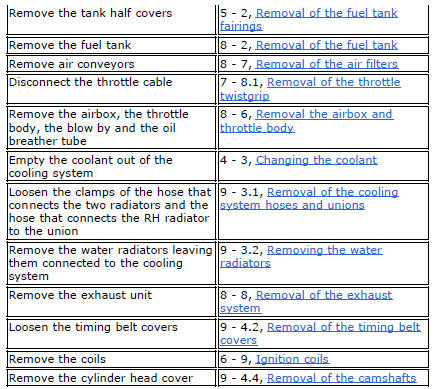
Note
For clarity, the figures show the engine removed from the frame.
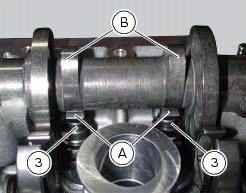
Move the piston of the cylinder being checked to tdc of the power stroke: in this condition, all the valves are closed and the timing shafts come in neutral position and, therefore, free to rotate; check to the valve clearance on the cylinder head on which it operates.
Checking the opening clearance
Using a feeler gauge, check the clearance between the opening rocker arm (a) and the lowest point of the camshaft lobe (b), taking care not to compress the rocker arm return spring.
The value must be within the specified ones (sect. 3 - 1.1, Timing system/valves).
If not, remove the opening adjuster (3), as described in paragraph "removing the valves" (sect. 9 - 4.5), And replace it with one of suitable height to obtain the prescribed clearance.
Note
Opening rocker arm shims measuring 1.80 To 3.45 Are available as replacement parts: the size is punched on the shim.
Checking the closing clearance
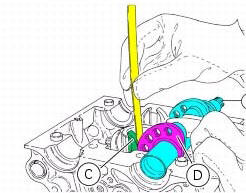
Using a feeler gauge, check the clearance between the closing rocker arm (c) and the highest point of the camshaft lobe (d).
The value must be within the specified ones (sect. 3 - 1.1, Timing system/valves).
If not, remove the closing adjuster (1), as described in paragraph "removing the valves" (sect. 9 - 4.5), And replace it with one of suitable height to obtain the prescribed clearance.
Note
Closing rocker arm shims measuring from 2.2 To 4.5 Are available as replacement parts: the size is punched on the shim.
 Checks and adjustments
Closing shim
Intake side camshaft
Opening shim
Exhaust side camshaft
Valve
Spare parts catalogue
Diavel abs cylinder head: timing system
Diavel abs vertical cylinder head
Diavel a ...
 Checking valve lift
Set the engine to the configuration described for the "checking and adjusting
the valve clearances", previously indicated.
Position the tool 88765.1518 On the cylinder head: the part marked "a" s ...
Other materials:
Rear-view mirrors
Rear-view mirror
Screw
U-bolt
Spring washer
Spare parts catalogue
Diavel abs handlebar and controls
Diavel carbon
abs
handlebar and controls
Important
Bold reference numbers in this section identify parts not shown in the
figures alongside the text, but which can be found in
...
Replacing the tank flange and fuel sensor
Loosen the screws (19) securing the fuel tank flange (20).
Remove the flange (20) from the tank (20).
Recover the seal (21).
Undo and remove the two fixing screws (g) and move the protection (f).
Before reassembly, carefully remove any deposits or scale from all parts.
Note
The flang ...
Checking the battery charging system
To check the current flow of the recharging circuit, use the "dds" diagnosis
instrument, which is equipped with an
inductive clamp-type amperemeter: refer to chapter "testing the battery charging
system", sect. 6 - 11
With the dds diagnosis instrument you can determine the engine rpm required ...