
Ducati Diavel Service Manual: Refitting the rear brake control
If the pushrod (18), clip (30) and fork (31) assembly has been dismantled, reassemble it by screwing the nut (29) onto the rod (18) and then screw the rod into the fork (31) to obtain the measurement indicated in the figure.
Block the rod and tighten to a torque of 7.5 Nm +/- 10% (sect. 3 - 3, Frame torque settings) the nut (29) on the fork (31).
Fit the pushrod assembly (18) on the lever (6) fixing it with the quick-release fastener (30).
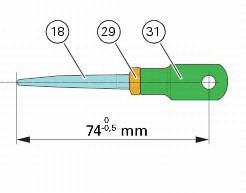
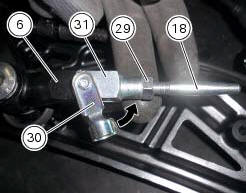
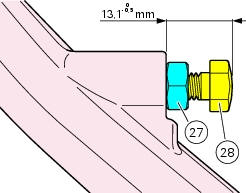
Check that the adjuster screw (27) and nut (28) are positioned at the distance apart shown.
Apply specific grease to the non-threaded surface of the pin (9).
Fit the first o-ring (11) in the pin (9).
Insert the pin (9) on the brake lever (6), apply the recommended grease to the seat of the second o-ring (11) of the lever (6) and place the other o-ring (11) and the washer (3).
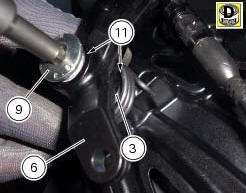
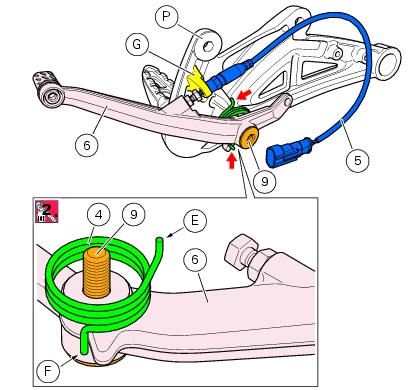
Fit the spring (4) on the rear brake lever (6) observing the orientation shown.
Apply the recommended threadlocker to the threaded side of the pin (9).
Fit the brake lever (6) on the footrest bracket (p) inserting the pin (9).
Note
On refitting, place the end (e) of the spring against the suitable rib of the bracket (p), making sure the other end (f) of the spring remains in place as shown.
Fit the rear stop sensor wire (5) tightening it manually onto bracket (g) and then to a torque of 10 nm +/- 10% (sect. 3 - 3, Frame torque settings).
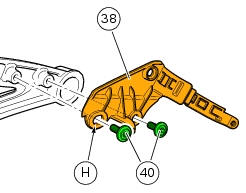
If removed, refit the master cylinder (38) on the bracket by starting the screws (40).
Note
Start the screw (40) first; this is the screw that sits in the slot (h).
Tighten the screws (40) to a torque of 4 nm +/- 10% (sect. 3 - 3, Frame torque settings).
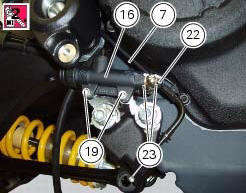
Reconnect the hose (7), locating the sealing washers (23) on both sides of the hose end fitting, and secure it with the special screw (22).
Tighten the special screw (22) to a torque of 23 nm +/- 10% (sect. 3 - 3, Frame torque settings).
Note
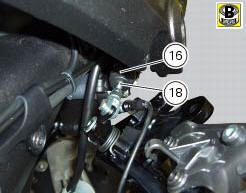
Pay special attention to the pipes (7) and (21) orientation on the rear brake master cylinder (16).
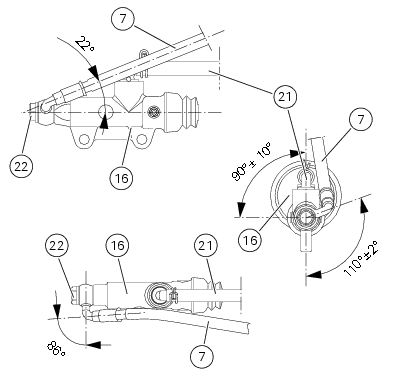
Insert the rod (18) inside the pump (16), after applying the recommended grease.

 Disassembly of the rear brake control
The brake master cylinder is supplied only as a complete unit; internal
components cannot be replaced.
To disassemble the master cylinder's outer parts, follow the indications given
in the expl ...
 Removal of the rear brake calliper
Important
The brake manufacturer advises against any servicing of the internal
components of brake callipers or the master cylinder.
Incorrect overhaul of these critical safety components can en ...
Other materials:
Removing the silencer
Loosen the clamp (38) that retains the silencer (4) to the complete exhaust
system.
While holding the nut (8), loosen the screw (1) and remove the silencer (4)
from the motorcycle.
Loosen the screws (40) and remove the silencer guard (41).
...
Flywheel - alternator
Screw
Alternator stator
Plug
Sealing ring
O-ring
Cover
Screw
Aluminium gasket
Screw
Bracket
Locating bush
Screw
generator cover
Flange
Flanged nut
Plane washer
Flywheel
Washer
Inner ring
Needle roller bearing
Electric starter driven gear
Starter clutc ...
Removal of the cooling system hoses and unions
Loosen the clips (21) that secure the radiator/thermostat sleeve (40) and the
radiator/plug sleeve (24) to the water
radiators.
Loosen clips (25) and (43) that secure the breather pipe (26) to the
radiator/plug sleeve (24) and to the left radiator.
Loosen the clips (34) securi ...