
Ducati Diavel Owners Manual: Engine setting function (engine power control)
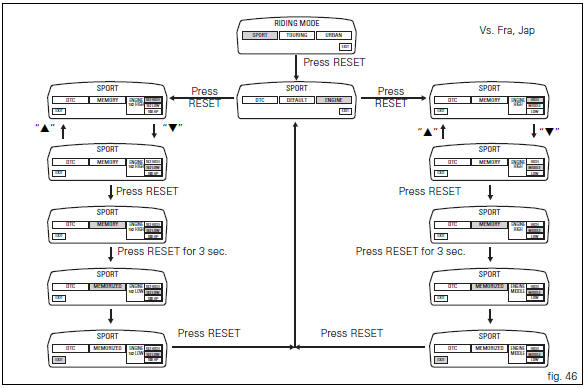
This function customises engine power and output.
To access the function it is necessary to view the "setting" menu page 48, using
button (1, fig. 14) ?"
"or (2, fig. 14) ?" "select the "riding mode"function
and press the
reset button (12, fig. 12) To go to next page.
Use button (1, fig. 14) ?" "or (2,
fig. 14) ?" "to select the riding
mode to be changed and press the reset button (12, fig. 12) To access the next
page. Now use button (1, fig. 14) ?"
"and (2, fig. 14) ?"
"to select the "engine" indication
and press the reset button again (12, fig. 12) To confirm
selection.
When accessing the function, the engine setting (engine 162 high, 162 low o 100 hp) appears at the right-hand side of the display, inside a rectangle.
 Note
Note
In japan and france versions, the display displays the settings (engine high, middle or low).
Using button (1, fig. 14) ?"" or
(2, fig. 14) ?" " select one of
the three available engine settings; after selecting the new
setting, press the reset button (12, fig. 12) To highlight
"memory" indication.
At this point, store the new setting by pressing and holding the reset button (12, fig. 12) For 3 seconds with "memory" displayed. If the setting has been stored successfully, the display will show "memorized" in green for 2 seconds and the exit option will be highlighted automatically.
To exit the setting function, press the reset button (12, fig.
12) Where "exit" is highlighted.
 Tips for use on the road
Activate the dtc, select level 8 and ride the motorcycle in
your usual style; if the level of dtc intervention seems
excessive, try reducing the setting to levels 7, 6, etc., Until
you find the lev ...
 Default function (resetting ducati default parameters)
This function resets the parameters set by ducati for each
riding style.
To access the function it is necessary to view the "setting" menu page 48, using
button (1, fig. 14) ?"
...
Other materials:
Overhaul of the gearbox
Check the condition of the front coupling dogs of the gears. They must be in
perfect condition and with no sign of wear on
the edges of the teeth.
The idler gears must rotate freely on their shafts.
When refitting, make sure the circlips are correctly positioned.
Check the needle roller ...
Draining the clutch hydraulic circuit
Warning
Clutch fluid will damage painted surfaces if spilled on them. It is
also very harmful if it comes into contact with the skin or
with the eyes; in the case of accidental contact, wash the affected area
thoroughly with plenty of running water.
Remove the dust cap to expose the bleed val ...
Display background colour (automatic adjustment)
Instrument panel background colour is set automatically
according to exterior lighting conditions.
When sensor detects "poor lighting" (night), it switches to
black background mode; vice versa when a "significant"
lighting is detected (day), it switches to white background
...