
Ducati Diavel Service Manual: Replacing the front phonic wheel sensor

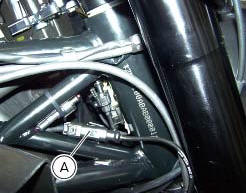
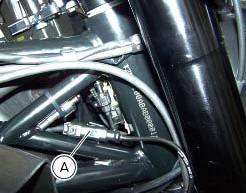
Disconnect the front abs sensor (2) connector (a) from the main electric wiring.
Open all the retainer clamps of the front abs sensor cable (2): refer to table of sect. 7 - 6, Flexible wiring/hoses positioning.
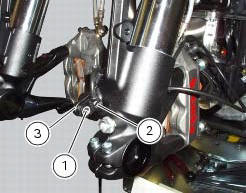
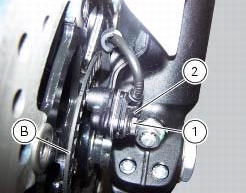
Loosen retaining screw (1) and remove the front abs sensor (2) with calibrated gasket (3).
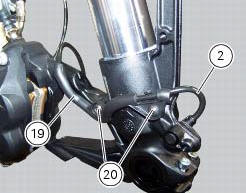
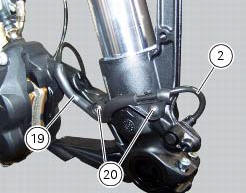
Undo the screws (20), remove the guide (19) and slide out the front abs sensor cable (2).
Before refitting, make sure that the contact parts between the front abs sensor (2) and its seat are not damaged and are perfectly clean.
Fit the new front abs sensor (2) in the relevant seat.
Insert the front abs sensor cable (2) in the guide (19) and fix it on the lh fork leg by starting the screws (20).
Tighten the screws (20).
Refit the front wheel as indicated in sect. 7 - 1, Refitting the front wheel.
Connect the connector (a) to the main wiring.
Restore all the retainer clamps of the front abs sensor cable (2): refer to table of sect. 7 - 6, Flexible wiring/hoses positioning.
Check the air gap between the front abs sensor (2) and the front phonic wheel (b) as indicated in sect. 7 - 7, Adjusting of the air-gap phonic wheel sensor.
Tighten the screw (1) to the torque of 10 nm +/- 10% (sect. 3 - 3, Frame torque settings).
 System components
Screw
Abs front speed sensor
Sealing washer
Hose grommet
Abs rear speed sensor
Abs control unit
Front pump - control unit pipe
Control unit - front callipers pipe
Rear pump - co ...
 Replacing the rear phonic wheel sensor
Disconnect the rear abs sensor (5) connector (c) from the main electric
wiring.
Open all the retainer clamps of the rear abs sensor cable (5): refer to table of
sect. 7 - 6, Flexible wiring ...
Other materials:
Low battery level
The activation of this (amber yellow) "warning" indicates that the status of
the battery vehicle is low.
It is activated when the battery voltage is ¼ 11.0 Volt.
Note
In this case, ducati recommends charging the battery as soon as possible
with the specific device, as it is possible th ...
Checking the fuses
The main fuse box (1) and the secondary one (2) are located in the tool tray;
to reach the fuse box remove the seat as
specified under sect. 5 - 3 "Removal of the seat".
The fuses are accessed by removing the cover, which shows the ampere ratings and
mounting locations.
For ampere ratings ...
Steering lock on indication
This function informs that the steering lock was turned on.
The steering lock can be turned on during the first 60
seconds after turning off the vehicle by pressing down on the
"run" button.
If the steering lock was enabled correctly, the instrument
panel will show the indication ...