
Ducati Diavel Service Manual: Reassembly of the tool tray
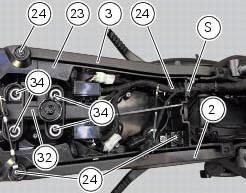
Place the tool tray unit (23) on the lateral brackets (2) and (3) by tightening the screws (24) to 14 nm +/- 5% (sect. 3-3, Frame torque settings).
If the handle guide (32) has been previously removed, position it on the tray (23) and tighten the screws (34) to 20 nm +/- 5% (sect. 3-3, Frame torque settings).
Reposition the wiring branch in the seat (s) in the tray (23).
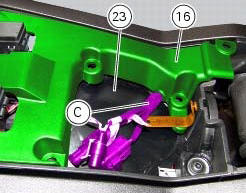
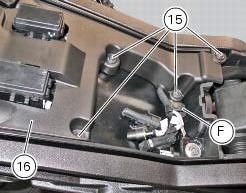
Place the gloves compartment cover (16) on gloves compartment (23), inserting wiring (c) into the suitable recess in the cover (16).
Warning
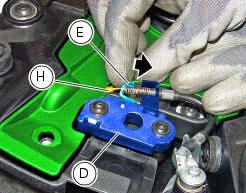
While positioning the cover (16) on the compartment (23), push bracket (e) of the lock latch (d) in the direction shown by the arrow, to prevent the lock wire terminal (h) from being squeezed under the cover.
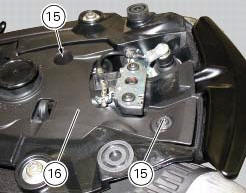
Check the presence of the clip (f) on the cover (16).
Fix the cover (16) by tightening the screws (15) to a torque of 4 nm +/- 10% (sect. 3 -3, Frame torque settings).
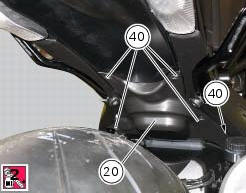
Apply the recommended threadlocker to the screws (40).
Reposition the splashguard (20) and tighten the screws (40) to a torque of 4 nm +/- 10% (sect. 3 -3, Frame torque settings).
 Reassembling the frame and the lateral footrests
Apply the recommended grease to the thread of the pins (9) and of the nuts
(8).
Place the frame (1) and the brackets (2) and (3) on the engine block. Start the
pins (9) by holding the nuts (8) ...
 Tail light - number plate holder
Rh tail light
Vibration damper mount
Spacer
Screw
Number plate light
Screw
Screw
Plate
Number plate holder
Nut
Screw
Rear chain guard
Lh tail light
Spring washer
Vib ...
Other materials:
Low beam lights not working
Location of connections and components
(A) injection relay; (b) etv relay (throttle valve operating engine); (c)
radiator fan relay; (d) hands free relay.
Fuses located at the rear left of the vehicle.
(1) 10A dashboard; (2) 5a engine control unit; (3) 15a key-sense; (4) 20a
injecti ...
Checking the battery charging system
To check the current flow of the recharging circuit, use the "dds" diagnosis
instrument, which is equipped with an
inductive clamp-type amperemeter: refer to chapter "testing the battery charging
system", sect. 6 - 11
With the dds diagnosis instrument you can determine the engine rpm required ...
Refitting the crankshaft/connecting rod assembly
Install the connecting rod assembly (6) and (2) in the crankcase, carry out
the shimming and crankcase half reassembly
procedure as described in sect. 9 - 9.2, Reassembly of the crankcase halves.
Important
Make sure that the connecting rods (2) are correctly positioned in the
cylinders. Incor ...