
Ducati Diavel Owners Manual: Key-on/key-off using the red key on the handlebar with the passive key
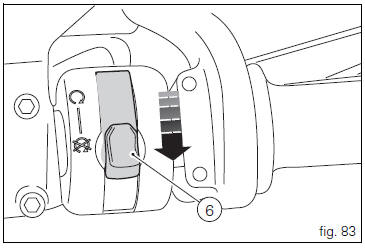
A key-on can be performed by pressing the red button (6) on the handlebar in the hands free on/off position and in the presence of the passive key (4, fig. 77).
 Note
Note
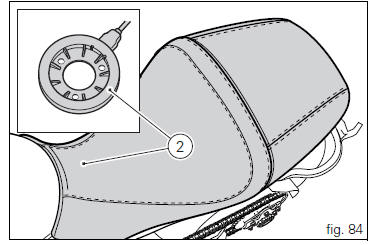
The passive key (4, fig. 77) Has a range of a few cm, therefore the key (4, fig. 77) Must be positioned near the antenna (2). Remove the seat (see "removal of the seat" on page 119) to access the antenna (2).
Key-off can be performed by pressing the red button (6) on the handlebar in the hands free on/off position. It can be done also without the key (4, fig. 77) Only if the motorcycle speed is equal to zero.
 Key-on/key-off using the key on the hands free lock with the active key
Key-on can be performed by pressing the button (7) on the
hands free lock (1, fig. 77) And with the presence of the
active key (3, fig. 77).
Note
The active key (3, fig. 77) Has a range of approx ...
 Key-on/key-off using the key on the hands free lock with the passive key
Key-on can be performed by pressing the button (7) on the
hands free lock and with the presence of the passive key (4,
fig. 77).
Note
The passive key (4, fig. 77) Has a range of a few cm,
theref ...
Other materials:
Indicator trip time - trip time
This function shows the vehicle trip time.
The calculation is made considering the time travelled since the last trip 1
reset. When trip 1 is reset, the value is set to
zero.
The active phase calculation occurs when the engine is running and the vehicle
is stopped (when the vehicle is not ...
California emission control warranty statement
Your warranty rights and obligations
The california air resources board is pleased to explain the
emission control system warranty on your my 2011
motorcycle. In california, new motor vehicles must be
designated, built and equipped to meet the state's stringent
anti-smog standards. Ducati north ...
General safety rules
Carbon monoxide
When a maintenance operation must be performed with the engine running, maker
sure that the working area is wellventilated.
Never run the engine in an enclosed space.
Warning
Exhaust fumes contain carbon monoxide, which is a poisonous gas that
can cause unconsciousness or e ...