
Ducati Diavel Service Manual: Overhaul of the crankcase halves
Carefully examine the engine crankcase halves.
Check that the surfaces of the crankcase halves are perfectly flat using a reference surface.
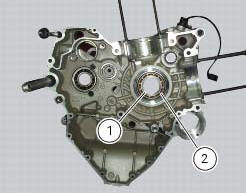
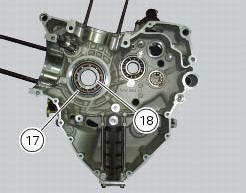
Check that the bearings (1) and (18), and the bushings (2) and (17) are in optimum conditions. Note that the main bearings must always be changed in pairs (refer to the procedure below in "main bearings").
Note
When overhauling an engine it is good practice to renew all the crankcase half bearings.
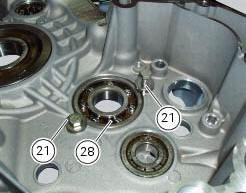
After having renewed the gearbox shaft bearings (28) and (9), secure them in the crankcase half with the spacers (21) and the retaining plate (10).
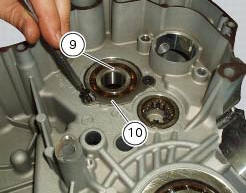
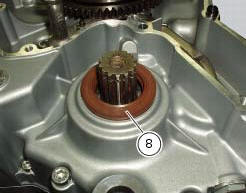
At each overhaul it is recommended to renew also the seal (8) on the outside of bearing (9).
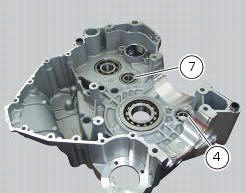
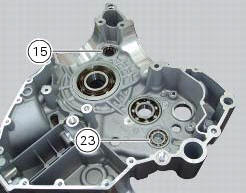
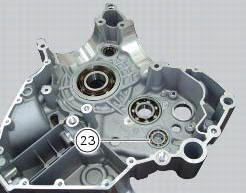
Renew the bearings (7) and (23) on the ends of the gearbox shafts and timing belt driveshaft bearings (4) and (15).
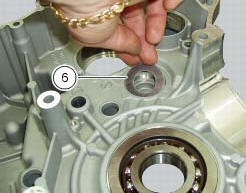
Take care not to lose the shim (6) interposed between the bearing (7) on the end of the gearbox primary shaft and the chain side crankcase half
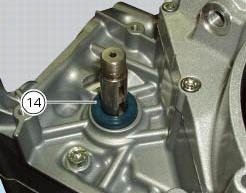
The seal (14) on the external side of the roller bearing (15) must be renewed at each engine overhaul.
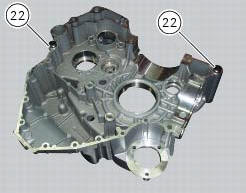
Check that the oilways are free of restrictions or clogging. Check the condition of locating bushes (22). If apparently distorted or loose in their seats, change them using proper tools. When the locating bushes (22) are hard to remove from casing, use a left-hand tap to force bushes out.
Important
The bushes (22) must always be renewed when they have been removed using the above procedure.
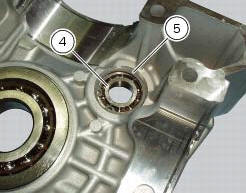
Remove the bearing (23), the circlip (5) and the roller bearing (4).
 Separation of the crankcase halves
Use two screwdrivers to remove the circlip (29) from the timing belt
driveshaft shaft (30) on the clutch-side crankcase
half.
Note
Take care to avoid scoring the surface of the shaft while re ...
 Main bearings
The main bearings have are of the angular contact type with offset inner
races so that the balls transmit loads from one
groove to the other along straight lines at an angle to the axis of the bear ...
Other materials:
Refitting the camshafts
If the stud bolts (2) were removed, apply the recommended threadlocker to the
short end of the stud bolts (2), i.E. The
end that is to be screwed into the cylinder head. Tighten the stud bolts (2) to
a torque of 10 nm (min. 9 Nm - max. 11
Nm) (sect. 3 - 3, Engine torque settings).
Check t ...
Removal of the rear wheel eccentric hub and rear wheel shaft
Before removing the eccentric hub, you must first remove the parts listed
below.
Slacken off the screws (34).
Remove the spacer (20) and the inner ring (21) on the chain side and remove the
wheel shaft (31) with the brake disc
(30) from the opposite side.
Remove the circlip (19 ...
Residual range indication when the service is due
After resetting the first oil service warning (triggered at 1000 km), upon
every key-on the system displays the
indication of which type of service should be performed next (oil service or
desmo service) and the residual range.
A (green) warning (1) is activated for 2 seconds on every key-on ...