
Ducati Diavel Service Manual: Water radiators
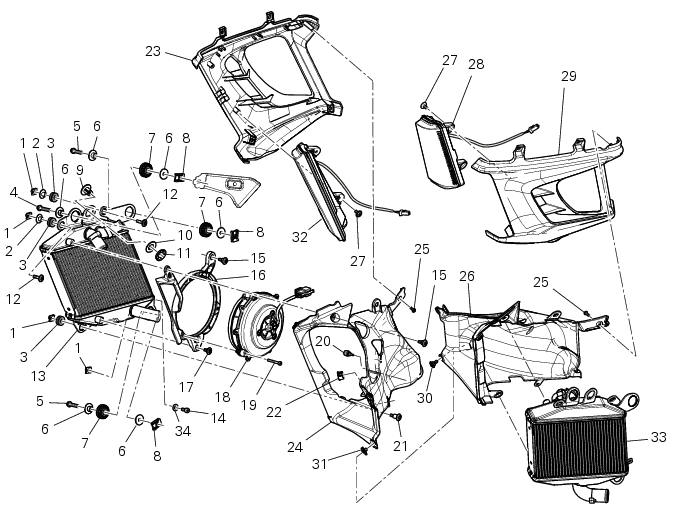
- Clip nut
- Spacer
- Vibration damper mount
- Screw
- Screw
- Spacer
- Vibration damper mount
- Clip nut
- Bush
- Spacer
- Rear sprocket
- Screw
- Water radiator (right)
- Screw
- Screw
- Air deflector (right)
- Special screw
- Electro-fan
- Screw
- Vibration damper mount
- Screw
- Plug
- Half-fairing (right)
- Internal air duct
- Screw
- Internal air duct
- Screw
- Front turn indicator
- Half-fairing (left)
- Special screw
- Clip nut
- Front turn indicator
- Water radiator (left)
- Washer
- Screw
Spare parts catalogue
Diavel abs radiator (right)
Diavel abs radiator (left)
Diavel abs half fairing
Diavel carbon abs radiator (right)
Diavel carbon abs radiator (left)
Diavel carbon abs half fairing
Important
Bold reference numbers in this section identify parts not shown in the figures alongside the text, but which can be found in the exploded view diagram.
The exploded view shows only the rh water radiator since the left one features the same components except the plug (22).
- Removing the water radiators
- Disassembling the water radiator unit
- Renewal of the cooling fan
- Reassembling the water radiator unit
- Refitting the radiator
 Refitting the cooling system hoses and unions
Position the pump/radiator sleeve (22) and the radiator/radiator sleeve (23).
Fit sleeve (23) and sleeve (22) to their corresponding fittings (n) and (o), and
bring them fully home on collars (p) ...
 Removing the water radiators
Loosen the screws (p) that retain the supports (s) of the front splashguard
to the air ducts (24) and (26).
Loosen the screws (30), to separate the two internal air ducts (24) and (26). ...
Other materials:
Coverage
Warranty defects shall be remedied during customary
business hours at any authorized ducati motorcycle dealer
located within the united states of america in compliance
with the clean air act and applicable regulations of the
united states environmental protection agency and the
california air r ...
Key to wiring diagram
Right-hand handlebar switch
Immobilizer
Hands free relay
Hands free
Front fuse box
Right fan
Left fan
Fan relay
Fuel pump relay
Ride-by-wire relay (etv)
Injection control unit (ems)
Rear fuse box
Data acquisition/diagnosis
Starter motor
Fused solenoid
Battery
Wirin ...
Steering head: steering
Screw
Steering head
Screw
Lower rh u-bolt
Lower lh u-bolt
Bearing
Screw
Sealing ring
Washer
Spacer
Washer
Nut
Washer
Screw
Bottom yoke
Dowel
Nut
Screw
Special screw
Clip nut
Left-hand support
Front splashguard
Right-hand support
Front support
S ...